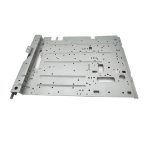
Metal coining is a forming method that forms undulating patterns or words on the metal surface through a mold.
Specifically, the metal sheet is placed between the upper and lower molds, and the material thickness changes under the action of pressure, and the extruded material is filled in the mold cavity with undulating fine lines, so as to form undulating bulges and words or patterns on the surface of the workpiece.

Basic principles and processes of metal coining
Metal coining is mostly carried out in a closed mold cavity to prevent the metal from being squeezed out of the mold after being pressed. For larger workpieces or workpieces with special shapes, an open mold cavity can be used for pressing. In the coining process, in order to ensure the quality and accuracy of the workpiece, it is usually necessary to anneal the blank, pickle or shot peen to ensure that the surface is clean and free of dirt. The accuracy of coining after forming can generally reach ±0.1mm in the thickness direction, and can reach up to about 0.05mm. In addition, the size of the blank for coining can be determined by the principle of equal weight before and after coining. And, when trimming is required after coining, the necessary trimming allowance should be added.
Application scenarios and advantages and disadvantages of metal coining
The metal coining process is widely used in the manufacture of various metal products, such as coins, medals, etc. Its advantages include high precision after forming, and the accuracy in the thickness direction can reach ±0.1mm, up to about 0.05mm. In addition, the coining process can also form various patterns and texts on the surface of parts to meet different decoration and identification needs.
Differences between metal coining and other surface treatment processes
Compared with the embossing process, the deformation depth of coining is larger and the required pressure is also greater. The deformation depth of the embossing process is smaller, and the required pressure is also smaller, which is usually performed on a smooth concave die. In addition, metal coining and other surface treatment processes such as laser engraving, hot stamping, relief printing, etc. are also significantly different in technical principles and application scenarios.
Finally, the metal coining process is widely used in manufacturing industries such as electronics, communications, automobiles, home appliances, etc. For example, patterns or texts achieved through coining are often seen in places such as mobile phone casings, car bodies, and electronic product sizes.
Of course, if you need large-scale metal coining services, you can choose to cooperate with Mulan Group, because Mulan Group is a professional Chinese sheet metal manufacturer with metal stamping, metal cutting and various sheet metal processing capabilities, which can meet your metal coining needs. Mulan Group is China’s earliest sheet metal manufacturing trade exporter. To serve customers in more than 30 countries around the world and establish long-term cooperative relationships. So you can rest assured to choose to cooperate with it. It is complete in experience and qualifications.
Here is our Metal coining parts Display: