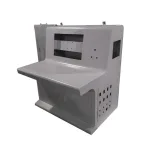
Sheet metal finishing processes primarily include cutting, punching, laser cutting, bending, and surface treatment.
Their core focus is achieving high-precision component formation through the use of precision equipment and technology. These are, of course, fundamental sheet metal processes, differing only in terms of equipment and operational expertise.
Cutting: Shears are used to cut thin metal sheets in straight lines. While generally accurate, they offer low cost and are suitable for simple pattern processing. The unfolded dimensions of the part must be calculated in advance, taking into account factors such as the bend radius and sheet thickness.
Blanking: Precision cutting of sheet metal using a punch press and die can achieve complex shapes such as high-precision holes and bosses. While die design is costly, it is suitable for high-volume production.
Laser Cutting: Laser cutting machines produce smooth, precise cuts on hard or complex materials, but the equipment costs are high. They are often used for material removal or for shapes that cannot be achieved by punching.
Bending and Forming: Press brakes mechanically bend sheet metal into three-dimensional shapes, requiring consideration of factors such as material ductility and boss height limitations. The design of the bending edge must avoid redundant material and poor contact.
Surface Treatment
Select electrostatic powder coating (high durability), liquid paint (low cost), or welding assembly (non-welding process) as needed to ensure aesthetically pleasing and functional surfaces.
How to ensure precision and surface quality in sheet metal finishing?
Sheet metal finishing is a critical process in the manufacturing industry. Its precision and surface quality directly impact product performance and service life. The following is a systematic approach to ensuring precision and surface quality in sheet metal finishing:
Key Measures for Precision Control
1. Equipment Accuracy
Select high-precision equipment: Use advanced equipment such as CNC laser cutting machines (accuracy ±0.05mm) and CNC press brakes (angular accuracy ±0.5°), and perform regular maintenance and calibration.
Equipment Maintenance: Check the back gauge positioning accuracy weekly (to within ±0.1mm) and maintain the hydraulic system oil temperature within the 20-40°C range.
Mold Management: Select molds based on material properties (e.g., Cr12MoV alloy steel molds for stainless steel) and regularly inspect mold wear (wear exceeding 0.05mm requires repair or replacement).
2. Process Optimization
Bending Compensation Calculation: Adjust the bending angle based on the material’s springback characteristics (aluminum rebound is 1°-3°, stainless steel 3°-5°). A “multi-step bending” process is used to minimize springback.
Expansion Design: Accurately calculate the bending coefficient, taking into account the influence of material thickness, hardness, and mold shape.
Processing Sequence: Follow the principles of “short side first, long side second” and “inner corners first, outer corners second” to reduce cumulative errors.
3. Material Control
Thickness Uniformity: Measure multiple points with a caliper and micrometer before use to select sheet metal with uniform thickness.
Internal Stress Management: Anneal materials with high internal stress to reduce the risk of processing deformation.
Batch Consistency: Materials within the same batch should have similar mechanical properties to avoid processing deviations due to material differences. Of course, the above are the main processes and details to pay attention to in sheet metal finishing. Generally, sheet metal factories will have detailed tolerance control ranges. Within a certain range, they all belong to sheet metal finishing. If you have large-scale customized sheet metal processing needs, you can choose to cooperate with Mulan Group. Mulan Group has 12 years of sheet metal manufacturing experience and is good at customized processing of various sheet metal shells, sheet metal brackets, sheet metal components and more. It has helped customers in more than 30 countries complete the commissioned tasks of sheet metal processing and has received unanimous recognition. We look forward to your cooperation consultation.
Here is our Custom sheet metal fabrication Sample Display: