How to calculate the bending allowance of sheet metal
When bend sheet metal, the required allowance is usually determined by the material thickness, bending angle and bending radius. Generally speaking, the allowance can be reserved according to 1.5 to 2 times the material thickness. For example, for a 1 mm thick sheet metal, the allowance should be between 1.5 and 2 mm. This value is based on industry practices and standards to ensure accuracy and quality during the bending process.
How to calculate the bending allowance of sheet metal
The calculation methods of sheet metal bend allowance mainly include the following:
Bending allowance definition: In the sheet metal bend process, the formed sheet metal bend has three dimensions: two profile dimensions and one thickness dimension. The profile dimensions are defined as L1 and L2, and the thickness dimension is defined as T. The bending allowance K factor is defined as the difference between L1+L2 and the unfolded length L. Specifically, the unfolded dimension L can be calculated by the formula L=L1+L2-K.
Bending allowance for materials of different thicknesses: For materials of different thicknesses, the value of the bending allowance K factor is also different. For example, for a 90-degree bend and a standard bending tool, the bending allowance of cold-rolled steel plates is as follows:
When T=1.0, K=1.8
When T=1.2, K=2.1
When T=1.5, K=2.5
When T=2.0, K=3.5
When T=2.5, K=4.3
When T=3.0, K=5.0
When T=0.8, K=1.6
When T=3.5, K=6.05
When T=4.0, K=7.0
When T=5.0, K=8.5.
Bending allowance for irregular bends: For irregular bends, a K factor of 0.5 can be used for calculation. In specific operations, AutoCAD can be used to draw the neutral layer for measurement, and if there is a deviation, it can be adjusted according to the specific situation. In addition, adjusting the lower die slot width can also adjust the deviation of the unfolded size to a qualified bending shape.
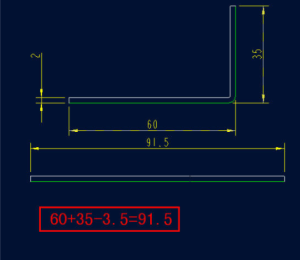
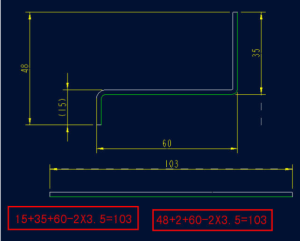

Specific calculation example: For example, for a sheet metal with two sides of 300mm each and a 90° angle, if it is a 2mm sheet, the bending coefficient is 0.6. The calculation method is as follows:
The length of the bending centerline is 300-2+0.3=298.3mm.
The unfolded length can be calculated by two methods:
Outer diameter calculation method: 300+300-3.4=596.6mm.
Inner diameter calculation method: (300-2)+(300-2)+0.6=596.6mm
The above is the basic method and example data for sheet metal bending calculation. In actual application, calculation needs to be performed according to specific circumstances.
For information about metal surface treatment processes and sheet metal fabrication services, feel free to contact Mulan Group Sheet Metal Fabrication, a leading sheet metal manufacturing service provider in China. We specialize in ODM/OEM metal processing and continuously update industry insights while delivering high-quality sheet metal services for your reference.
Here is our Sheet Metal sample Display: